Clients
Clients are the people your firm collects documents from. This guide shows firm users how to add and manage clients, how clients receive access to their requests, and how to keep client records organized.
Clients never need a FileOnion account
Clients do not sign up, set passwords, or log in. When you send a request, your client receives a branded email or text message containing a secure magic link that opens their upload page directly. See Client Portal for what that experience looks like.
A client doesn't even need an email address — a mobile number is enough. See Clients without an email address.
The client list
Open Clients from the left sidebar. The list is ordered so the clients who need you appear first, not alphabetically.
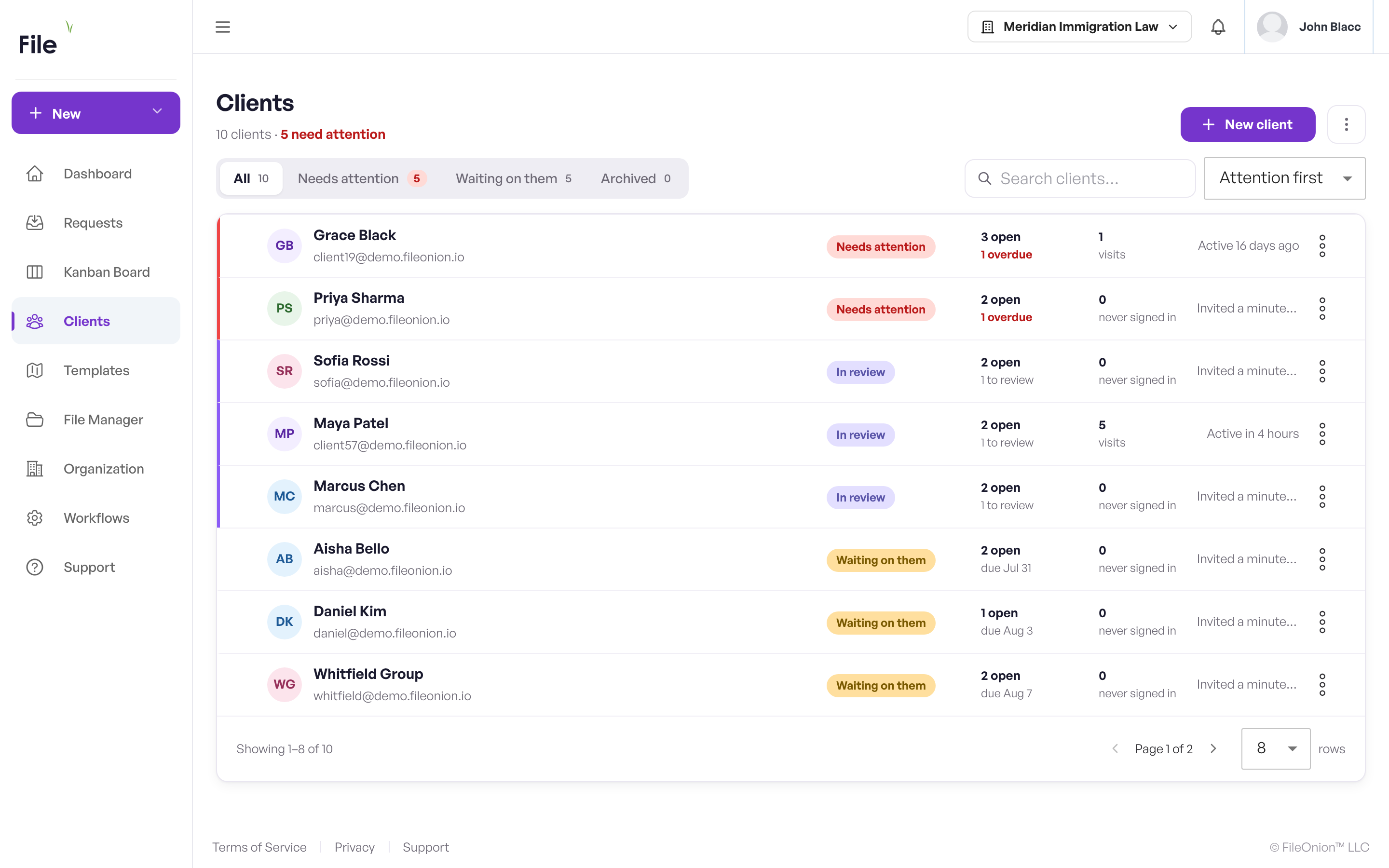
The heading tells you where you stand — "24 clients · 3 need attention" — and the "need attention" part is clickable: it jumps straight to those clients.
Segments
Four segments sit above the list, each showing a live count:
| Segment | Who's in it |
|---|---|
| All | Every active client |
| Needs attention | Clients with an overdue or expired request, or files sitting in your review queue. The count shows as a red pill when it isn't zero. |
| Waiting on them | Requests are out; the ball is in the client's court |
| Archived | Clients you've archived |
Sort
The Sort menu offers four orders:
- Attention first (default) — attention, then in-review, then waiting, then caught-up; most overdue first inside each group.
- Name A–Z
- Last activity
- Newest
Search
Type in the Search clients… box. Matching is case-insensitive and covers name, email, and company, so smith, Smith, and acme all work.
Reading a row
Each row carries a colored urgency rail on the left (red for attention, purple for files in review) and a live status chip:
| Chip | Meaning |
|---|---|
| Needs attention | Something is overdue, expired, or waiting on your review |
| In review | Files have landed and are waiting for you |
| Waiting on them | The client still owes you documents |
| All caught up | Nothing outstanding |
| Archived | This client is archived |
Next to the chip, an open-requests stat reads e.g. "3 open" with a sub-line of "1 overdue", "2 to review", or the next due date. Wider screens also show the client's visit count. Hovering a row swaps the last-activity timestamp for quick actions and a ⋮ menu: New request, Edit client, Archive client / Unarchive client, and Delete client.
Click anywhere on the row to open the client.
Bulk actions
Hover a row and a checkbox appears on the left. Select one or more clients and the control bar becomes a selection bar reading "N selected" with Archive (or Unarchive, in the Archived segment), Delete, and Clear. If part of a bulk action fails, FileOnion tells you exactly how many succeeded and how many didn't.
Paging through the list
The footer reads Showing 1–8 of 11, with prev/next arrows and a rows selector offering 8, 16, 24, 32, or 40 per page. Paging applies after your segment, search, and sort — so "Showing 1–8 of 11" means 11 clients matched, not 11 clients total.
Export
Export CSV lives in the ⋮ menu beside the New client button, labeled with the number of clients it will export. It exports everything that matched, not just the page you're looking at.
Very large client lists
The list loads up to 1,000 clients at a time. Past that you'll see "Showing the 1,000 most recent clients — search to find anyone else", and search falls through to the server so you can still find anyone.
Adding a client
- On the Clients page, click New client.
- Fill in the form:
- First name and Last name (required).
- Email (optional with phone) — where request notifications and magic links are sent. Leave it blank to add a phone-only client. Once a client has a real email address it cannot be changed, and the format is validated when you save.
- Phone — required if you leave the email blank, or if you pick SMS or WhatsApp below. Optional otherwise.
- Company (optional).
- Portal language — English or Spanish. See below.
- Notifications — how this client receives request notifications and reminders: email, SMS, or WhatsApp.
- Optionally check Send an invite email right away ("They'll get a secure portal link — no password to set up.").
- Click Add client.
You must give a client either an email address or a phone number. Leaving both blank stops the save with "Add an email address or a phone number".
Checkpoint
The new client appears in your client list. You can now create a request for them — from the row's ⋮ menu, choose New request.
Clients without an email address
Some clients simply don't have an email address, or never check the one they have. You can add them with just a name and a mobile number — they receive their requests by text message and sign in with texted links.
To add one, fill in the New client form as usual but leave Email blank and enter a Phone number. The form adapts as soon as it has a phone number and no email:
- Notifications drops the Email option — a text channel (SMS or WhatsApp) is selected for you, because there is no mailbox to send to.
- A required consent checkbox appears: "This client agreed to receive text messages". You cannot save without it.
- The invite checkbox becomes "Send an invite text right away" — "They'll get a secure sign-in link by text — no password, no email needed."
The consent checkbox is a legal attestation, not a formality
By ticking it you are confirming, on the client's behalf, that they agreed to receive text messages from FileOnion at that number — including document requests, sign-in links, and verification codes, with standard message and data rates, HELP for assistance and STOP to opt out. FileOnion records who attested and when. Only tick it if the client actually agreed.
How a phone-only client signs in
They never type an address or a password. Every link they receive is a secure magic link: they tap it, FileOnion texts them a one-time code, they enter the code, and their portal opens.
This is automatic and cannot be turned off for these clients — if you publish a request with With magic link or Without magic link selected, FileOnion still sends the secure variant, because a plain link is not something they could sign in from.
If you checked Send an invite text right away, first contact is a text with that secure sign-in link. It always goes by SMS, even for a client set to WhatsApp.
What they get, and what they don't
| Phone-only client | |
|---|---|
| New request notification | ✅ Text message with a secure link |
| Sign-in and verification codes | ✅ Text message |
| The portal, uploads, comments, shared files | ✅ Identical to any other client |
| Automatic reminders | ❌ Reminders are email-only, so these clients are skipped |
| "File shared with you" notification | ❌ No ping — the file still appears in their Shared files |
For the two gaps, tell the client directly, or resend the request from its row menu to text them a fresh link.
Adding an email address later
If a phone-only client gets an email address, open Edit client and type it into the Email field — for these clients the field is editable, and the help text reads "This client signs in by text message. Add an email address to enable email sign-in and notifications."
Saving upgrades them in place: same client record, same requests, same files, same history. From then on they behave like any other client — email notifications, reminders, and email sign-in all switch on, and the email address locks like everyone else's. If the address is already used by another account, the save is rejected so two records can't collide.
Portal language
Portal language sets the language this client sees and receives. Choosing Spanish switches the client-facing side to Spanish:
- Request emails, reminders, and magic-link messages
- Approve, decline, and comment notifications
- File-shared notifications
- Workflow stage-transition emails
- The upload portal itself
Text messages are sent in Spanish too. A Spanish client on SMS or WhatsApp receives the new-request, file-approved, file-declined, and new-comment texts in Spanish, and a phone-only client gets their invite text in Spanish as well.
Your firm's own interface is unaffected — only what this client sees changes. Invitation emails and email-verification messages are still sent in English.
You can confirm the setting at a glance: a client whose portal language is Spanish shows a Portal in Spanish marker on their detail page.
Editing, archiving, and deleting
- Edit — open the row's ⋮ menu (or the menu on the client's detail page) and choose Edit client. All fields except the email address can be changed. The one exception is a phone-only client: their Email field stays editable so you can add a real address later, and until you do, their phone number and text-based notification method can't be removed — it's the only way they can sign in.
- Archive — hides the client from your active list without losing anything. Archived clients are hidden from client pickers and can't receive new requests. They appear under the Archived segment, where you can Unarchive them at any time.
- Delete — permanently removes the client record. A confirmation dialog asks you to confirm with Yes, delete.
Tip
Prefer archiving over deleting for former clients. Archiving is reversible and keeps your history intact.
The client detail view
Click any client to open their detail page.
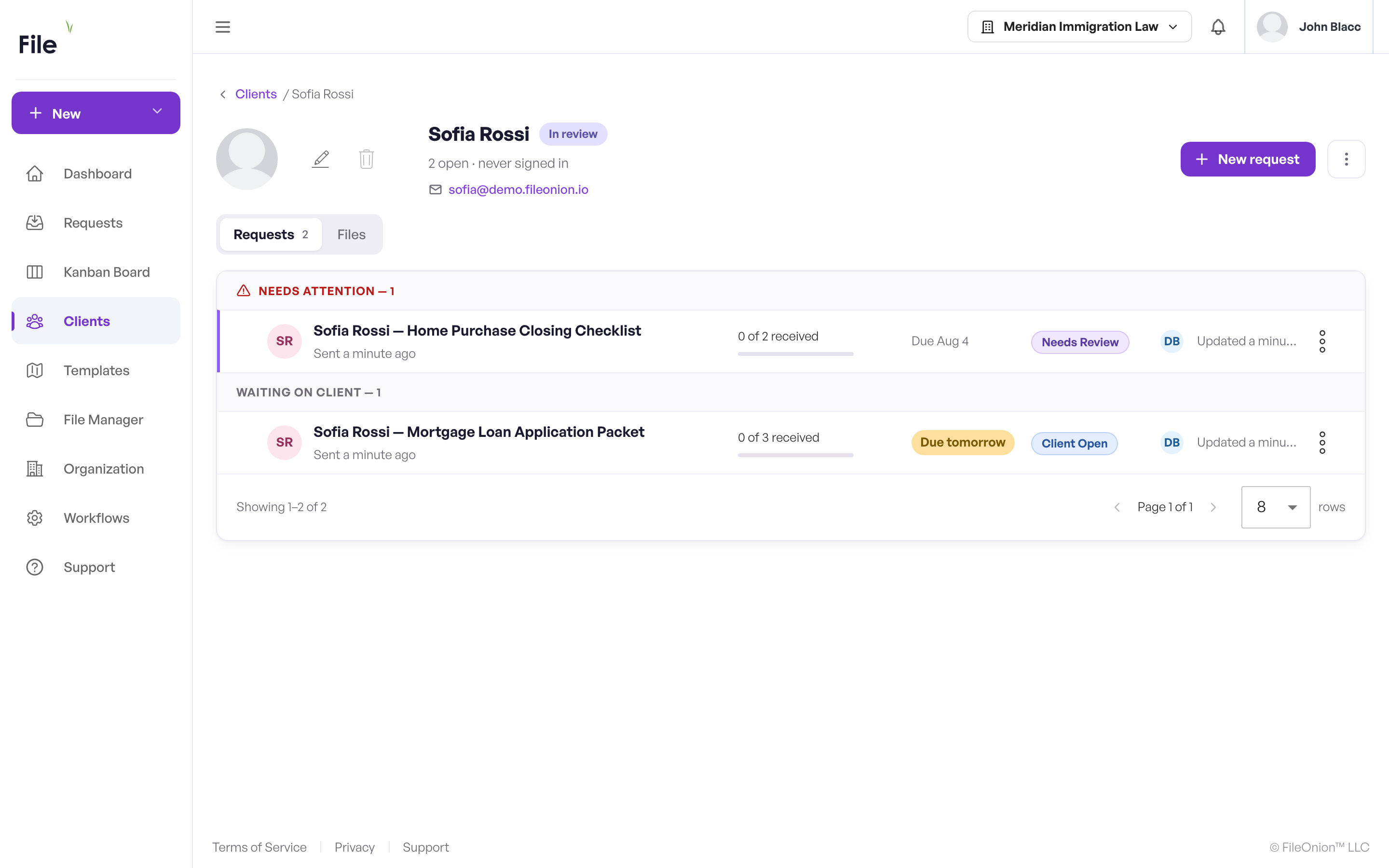
The header band shows their avatar, name, and the same live status chip as the list, plus a one-line summary: "3 open · 1 overdue · last active 3 days ago" (or "never signed in"). Below it, a contact row gives you a clickable email and phone, the company, and — when set — the Portal in Spanish marker. A phone-only client shows their phone number wherever an email would normally appear — in the list, on this page, and in the client pickers on the request composer and the share dialog.
On the right: a New request button and a ⋮ menu with Edit client, Archive client / Unarchive client, and Delete client. If the client is archived, a banner sits above the band with an Unarchive button.
Two tabs sit under the header:
-
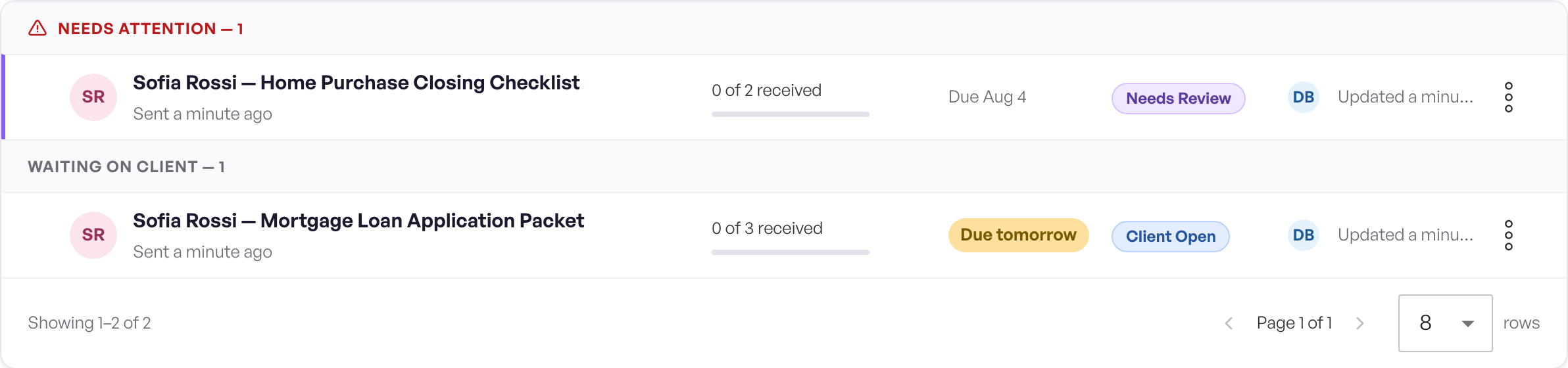
Requests — every request sent to this client, grouped attention-first under NEEDS ATTENTION, WAITING ON CLIENT, and DONE headers with counts, eight per page. Only the groups that have something in them are shown. Every per-request action from the main Requests page is available here: edit, archive, delete, publish, resend a magic link or secure link, copy the client link, assign to a teammate, and set visibility.
-
Files — this client's files, in the full File Manager, scoped to them.
To share files back to this client, use the File Manager — open a file's menu, choose Share, and pick the client (see Sharing files with clients).
How clients access their requests
When you send a request, FileOnion notifies the client through their preferred channel (email, SMS, or WhatsApp) with a branded message containing a magic link. Opening the link takes the client straight to their request — no password required. When sending, you can choose:
- With magic link — the standard one-click access link.
- With secure magic link — adds a one-time verification code the client must enter before the request opens.
- Without magic link — sends the notification without an access link (available once the client has already been notified).
See Client Portal for the client-side experience.
Resending access
Magic links expire. If a client reports that their link no longer works, open the request and click Resend — the same button you used to send it. This issues a fresh notification with a new link. If a notification fails to deliver, FileOnion tells you so you can resend it from the request page.
Reminders
When composing a request, enable Reminders and choose how often to nudge the client. Reminders are delivered over the client's notification preference — email, SMS, or WhatsApp — so make sure a phone number is on file for clients who prefer text messages.
Previewing what a client sees
To check a request's content from your client's perspective before sending it, open a preview of the template behind it. The preview renders the same view your client gets, in read-only mode — a banner notes that upload, complete, and comments are disabled. See Templates for details.